Italian Skydiving Championship Guide: FCL and VFS
The Italian FCL/VFS Championship runs on three events (4-Way FS, 4-Way VFS, 8-Way FS) under Aero Club d'Italia authority, with regulation aligned to the FAI Sporting Code Section 5. The goal is to score as many valid formations as possible within working time (35 or 50 seconds). The 114 official figures of the Dive Pool — 22 blocks + 16 randoms per event — are published in the six Addenda of the Regulation.
Source: Italian Skydiving Technical Regulation — Formation Skydiving / Vertical Formation Skydiving — Italian Championship, Aero Club d'Italia (in force). All references in this guide point to that official document. For the up-to-date and binding regulatory text, always refer to the original.
What is FCL and what is VFS
Competitive team skydiving splits into two main families. FCL — Formazioni in Caduta Libera (Formation Skydiving, FS): skydivers fly belly-to-earth, building and rebuilding geometric figures by gripping each other. VFS — Formazioni Verticali in Caduta Libera (Vertical Formation Skydiving): skydivers fly vertically — head down or head up — building three-dimensional formations of significant technical complexity.
In both disciplines the goal is to score as many valid formations as possible within the working time of each jump.
Governing authority
The Italian Championship is run under the authority of the Aero Club d'Italia, in compliance with the Regolamento Sportivo Nazionale (RSN) and the rules of the FAI Sporting Code (Fédération Aéronautique Internationale), General Section and Section 5, approved by the IPC (International Parachuting Commission). By entering, every competitor accepts these rules as binding.
Vocabulary of the discipline
Before diving into the rules, it helps to know the official technical vocabulary used by judges and athletes.
Formation
A set of competitors held together by grips. In VFS, every competitor must be in the correct orientation (head down or head up).
Grip
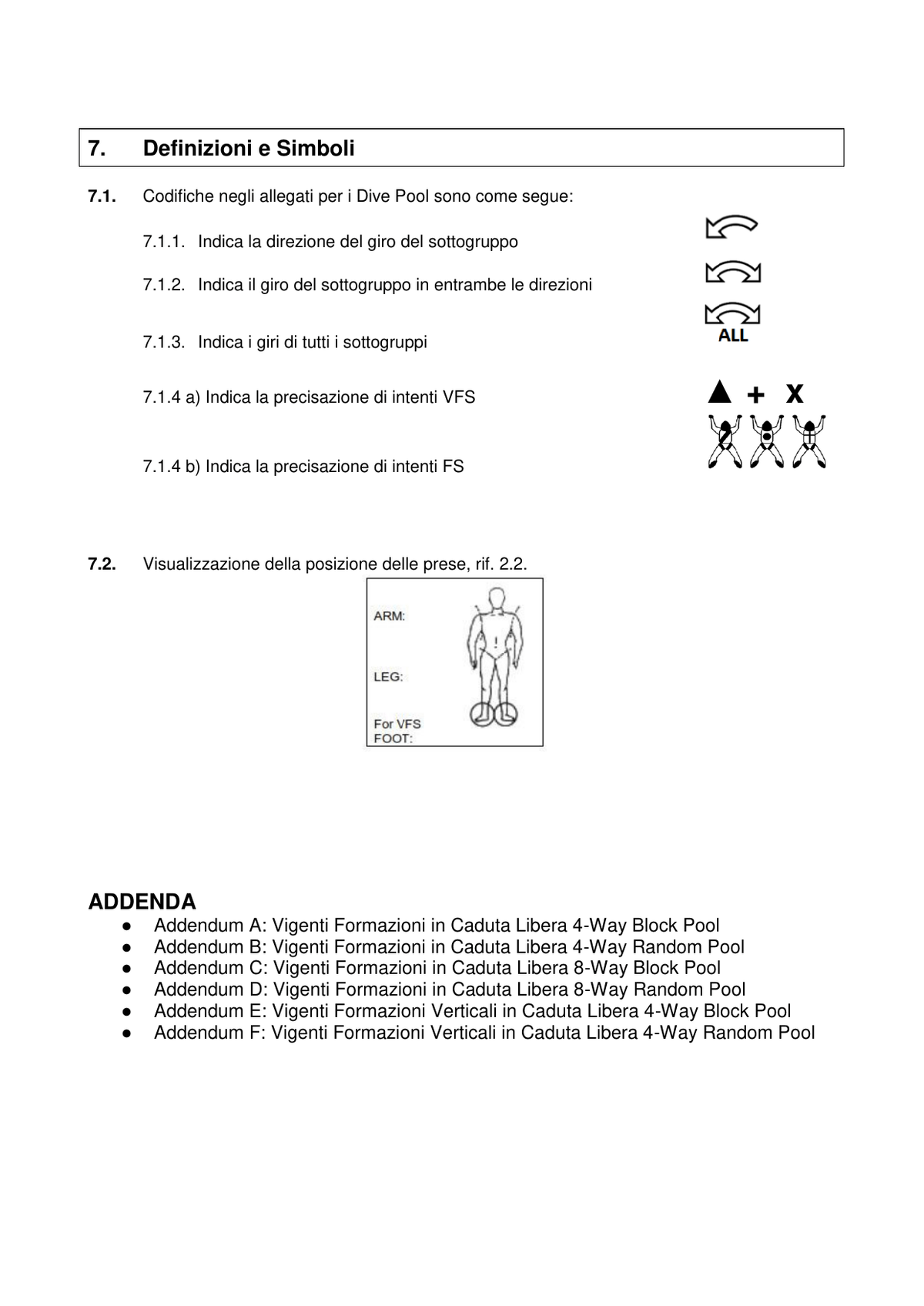
Firm contact of one hand on another competitor's arm, leg or foot. A grip requires at least one firm contact (ref. § 7.2 of the Regulation).
Grip line
The ideal line connecting the torsos of two competitors through their arms/legs and the grip joining them. In VFS, no grip line may cross another within a formation.
Dive Pool
The official catalog of all competition figures: it includes Random Formations (single static figures, identified by letters) and Block Sequences (transitions, identified by numbers), described in the regulation Addenda. On Quota 4000 the full dive pool — 114 formations with official diagrams — is browseable in the Dive Pool Browser tool.
Subgroup
A single competitor or a group of competitors connected together, who must complete a specific manoeuvre during an inter or block sequence.
Total separation
The moment when all competitors simultaneously release all grips and no part of their arms is in contact with another body. It signals that a formation is complete and the next can be built.
Inter
The intermediate condition within a block sequence: must be performed exactly as depicted in the dive pool.
Sequence
The series of Random Formations and Block Sequences to be performed in a single jump, drawn before the round.
Valid formation
A correctly completed formation clearly presented to the judges, preceded (except for the first one after exit) by a correct total separation or inter. It must be performed under control, but not necessarily perfectly symmetrical.
Bust (infringement)
Occurs in three cases:
- a wrong or incomplete formation, followed by a total separation or inter (correct or not);
- a correctly completed formation preceded by an incorrect inter or total separation;
- a formation, inter or total separation not clearly presented to the judges.
Omission
Occurs when a formation or inter is skipped in the drawn sequence, or when the intent to build the correct figure is unclear and another figure is presented to gain advantage.
Working Time
The timed period during which teams are evaluated. It starts when one competitor (excluding the Video Operator) separates from the aircraft and ends after a number of seconds set by the event.
NV — Not Visible
When formations, inters or total separations are not visible on video due to weather conditions or technical issues with the video equipment, beyond the athletes' control.
VFS orientations
- Head Down: vertical torso, head toward the ground
- Head Up: vertical torso, head toward the sky
- Belly to Earth (Bellyflying): prone, front toward the ground (not used in VFS)
- Backflying: prone, back toward the ground (not used in VFS)
The competition events
The Italian Championship has three official events:
- 4-Way FS — 4 skydivers, belly. Exit altitude 3,050 m / 10,000 ft AGL. Working time 35 seconds.
- 4-Way VFS — 4 skydivers, vertical. Exit altitude 3,960 m / 13,000 ft AGL. Working time 35 seconds.
- 8-Way FS — 8 skydivers, belly. Exit altitude 3,960 m / 13,000 ft AGL. Working time 50 seconds.
Altitude and working time on bad weather
Only for weather reasons, with the consent of the FAI Controller (if appointed) and the Chief Judge, the Meet Director may modify altitude and/or working time:
- Reduced working times allowed: 20 or 35 seconds for 4-Way FS and VFS; 30 or 50 seconds for 8-Way.
- Minimum altitude: 2,150 m / 7,000 ft AGL for 4-Way FS; 2,750 m / 9,000 ft AGL for 4-Way VFS and 8-Way.
- Maximum altitude: 3,960 m / 13,000 ft AGL for all events.
How scoring works
The base point
The team earns 1 point for every valid formation completed in the sequence within Working Time. Once the sequence is completed, it restarts from the beginning: there is no cap on repetitions.
Penalties
- Omission: –3 points. If both the inter and the second formation of a block sequence are omitted, it counts as a single omission.
- Minimum score per round: zero (no negative scores).
Tie-breaking
If two or more teams finish with the same score, the following are applied in order:
- A tie-breaker round (only for the top three places).
- Highest score in any completed round.
- Highest score starting from the last round in reverse order.
- Fastest time (in hundredths of a second) of the last formation judged without infringement in the last round.
General competition rules
Team composition
- Teams may be mixed (men and women), except in the women's event where every competitor (excluding the Video Operator) must be a woman.
- No competitor may be in more than one team in the same event, nor compete in more than two FCL events (including VFS).
- The Video Operator is a full team member and registered as such.
The draw
- Sequences are drawn publicly, supervised by the Chief Judge.
- Teams are guaranteed at least 2 hours between the draw announcement and the start of competition.
- Each block or formation is drawn only once for the planned rounds. In tie-breaks, draws come from the residual dive pool.
Wind tunnel
After the draw, wind tunnel use is not allowed (freefall simulator).
Competition video
Each team must provide a video track for every round. The equipment must transmit a digital HD 1080 signal at minimum 25 fps, record on a memory card (class 10 minimum) and be delivered to the dubbing station as soon as possible after each jump. The video track remains available until the final scores are posted.
Practice jumps and rejumps
Each team is entitled to 1 official practice jump before the draw. A rejump is granted in case of NV, unless the Video Review Panel finds intentional abuse (in which case: zero points). It is not granted for contacts or interferences between teammates, adverse weather during the jump, or technical issues with competitors' equipment.
Judging system
Jumps are judged as soon as the Video Operator delivers the track, in reverse standing order as far as possible. At least 3 judges must score every jump. The first viewing is at normal speed to set the score and the freeze frame at the end of Working Time. On contestation, a second viewing is possible at slowed speed (50–90% of normal) and, on the Event Judge's request, a third.
To award a point, assign a bust, an omission or declare an NV, the majority of judges must agree.
The clock is started by the Judges when one competitor separates from the aircraft. If judges cannot determine the start of Working Time, the count starts from the Video Operator's separation, with a 20% penalty on the jump score.
Italian Championship programme
Titles at stake
- Italian 4-Way FS Champion (Open and Women)
- Italian 4-Way VFS Champion
- Italian 8-Way Champion
Round structure
- 4-Way FS: 10 rounds (8 preliminary + semi-final + final)
- 4-Way VFS: 10 rounds (8 + semi-final + final)
- 8-Way FS: 8 rounds
All teams compete in the first 8 rounds. Rounds 9 (semi-final) and 10 (final) of the 4-Way events are reserved to a percentage of teams set by the Meet Director. The Championship is valid with at least 4 teams entered per event and at least 1 valid round completed.
Protests
Protests follow point 5.3 of the FAI Sporting Code - Section 5. The protest fee is € 50, refundable if upheld.
The Dive Pool: official formations
The Dive Pool is the complete catalog of figures that can be drawn in competition, split into six addenda — three for FCL (4-Way Block, 4-Way Random, 8-Way Block, 8-Way Random) and two for VFS (4-Way Block, 4-Way Random). Blocks (Block Sequences) are shown in three phases: starting formation → inter → ending formation. Randoms are single static figures.
Every formation is graphically coded: a directional arrow shows the rotation direction of the subgroup, a bidirectional arrow allows rotation either way, a circle indicates a foot grip. In VFS diagrams, ▽ indicates head-down orientation and △ indicates head-up.
Addendum A — 4-Way FS Block Pool · 22 blocks
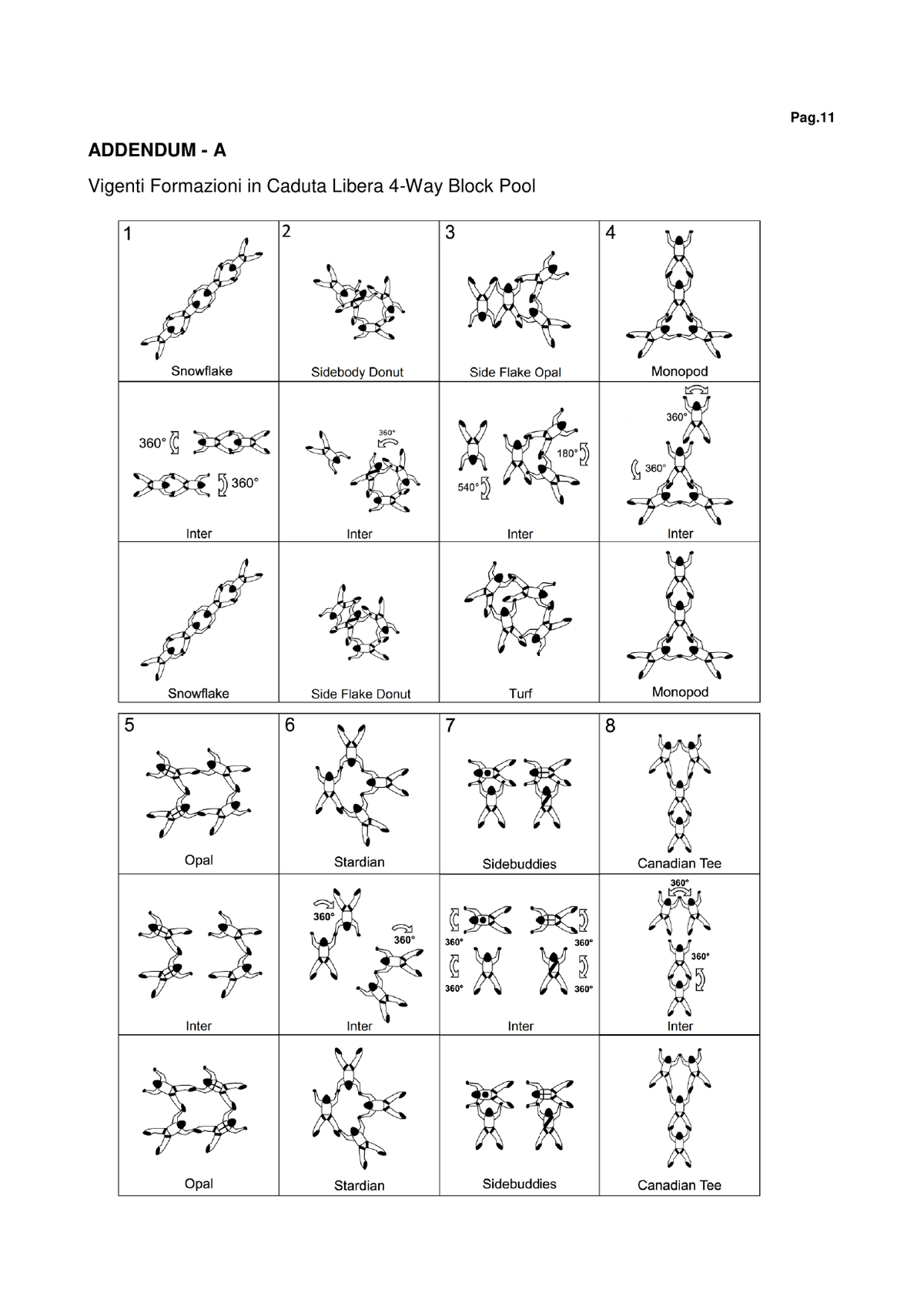
Snowflake → Snowflake · Sidebody Donut → Side-Flake Donut · Side Flake Donut → Turf · Monopod · Opal · Stardan · Sidebuddies · Canadian Tee · Cat + Accordian · Diamond → Bunjy · Photon · Bundy · Offset → Spinner · Bipose · Caterpillar · Compressed → Box · Danish Tee → Murphy · Zoom · Ritz → Icepack · Piver → Viper · Zig Zag → Marquis · Tee → Chinese Tee.
Addendum B — 4-Way FS Random Pool · 16 figures
Unipod (A) · Stairstep Diamond (B) · Murphy Flake (C) · Yuan (D) · Meeker (E) · Open Accordian (F) · Cataccord (G) · Bow (H) · Donut (J) · Hook (K) · Adder (L) · Star (M) · Crank (N) · Satellite (O) · Sidebody (P) · Phalanx (Q). Letter I is skipped to avoid confusion with the number 1.
Addendum C — 8-Way FS Block Pool · 22 blocks
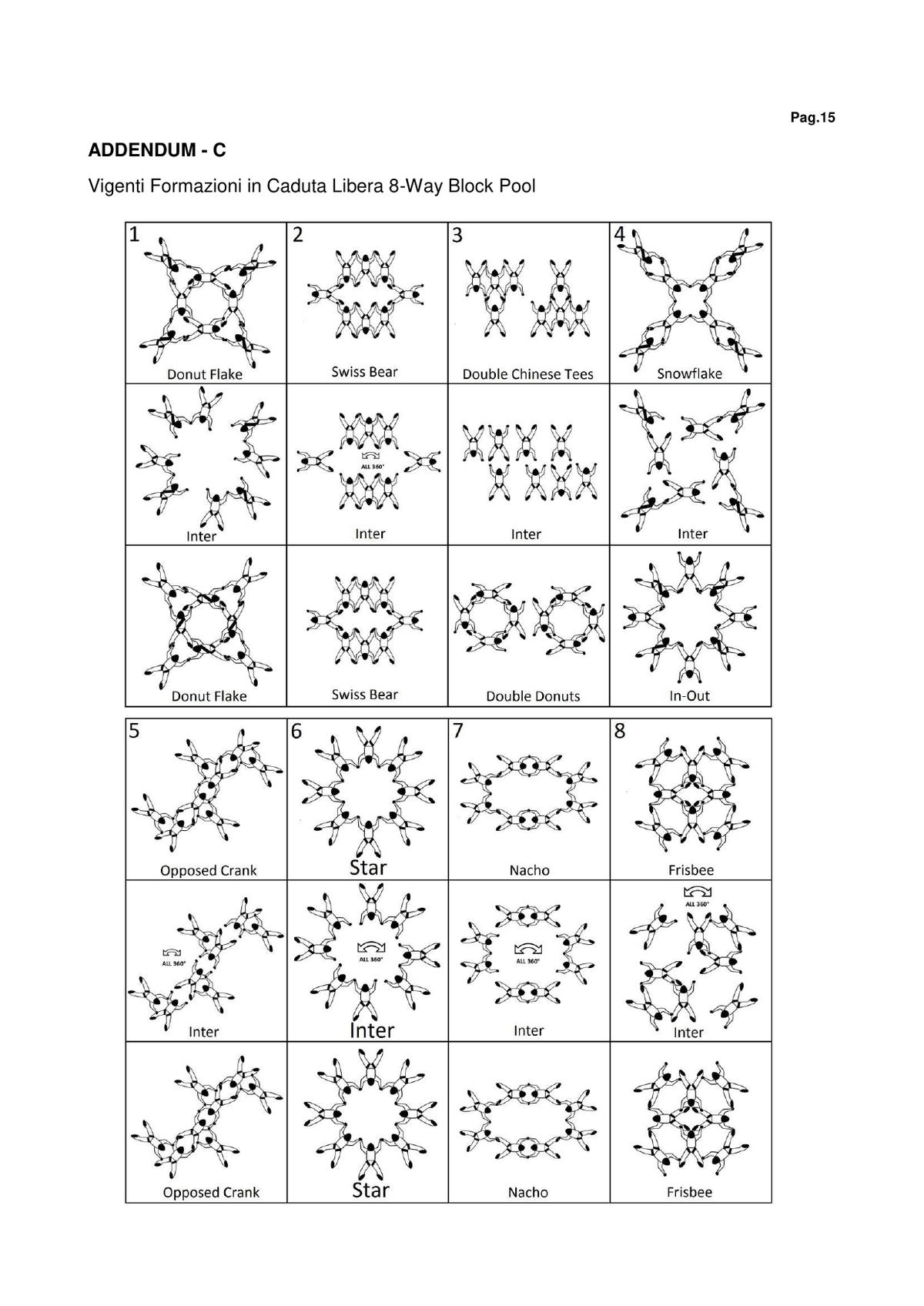
Donut Flake · Swiss Bear · Double Chinese Toss → Double Donuts · Snowflake → In-Out · Opposed Crank · Star · Nacho · Frisbee · Taj → Mahal · Donut · Norwegian Box → Norwegian Donut · Stereo Bipolies → Stereo Bipoles · Double Satellite · Accordian → Opposed Starlines · Opal & Zipper → Zipper & Opal · Canadian Tees → Monopods · Buzzard · Sidebody Donut · Compressed Diamonds · Cat Diamond → Cat Accordian · Staropod → Compressed Starling Staropod · Old Bona → Compressed Starling Staropod.
Addendum D — 8-Way FS Random Pool · 16 figures
Caterpillar (A) · Stairstep (B) · Hourglass (C) · Hope Diamond (D) · Rubik (E) · Diamond Flake (F) · Arrowhead (G) · Iroquois (H) · Springbok (J) · Crossbow (K) · Open Facing Diamond (L) · Double Spiders (M) · Zipper Flake (N) · Compressed Accordion (O) · Venus (P) · Compass (Q).
Addendum E — 4-Way VFS Block Pool · 22 blocks
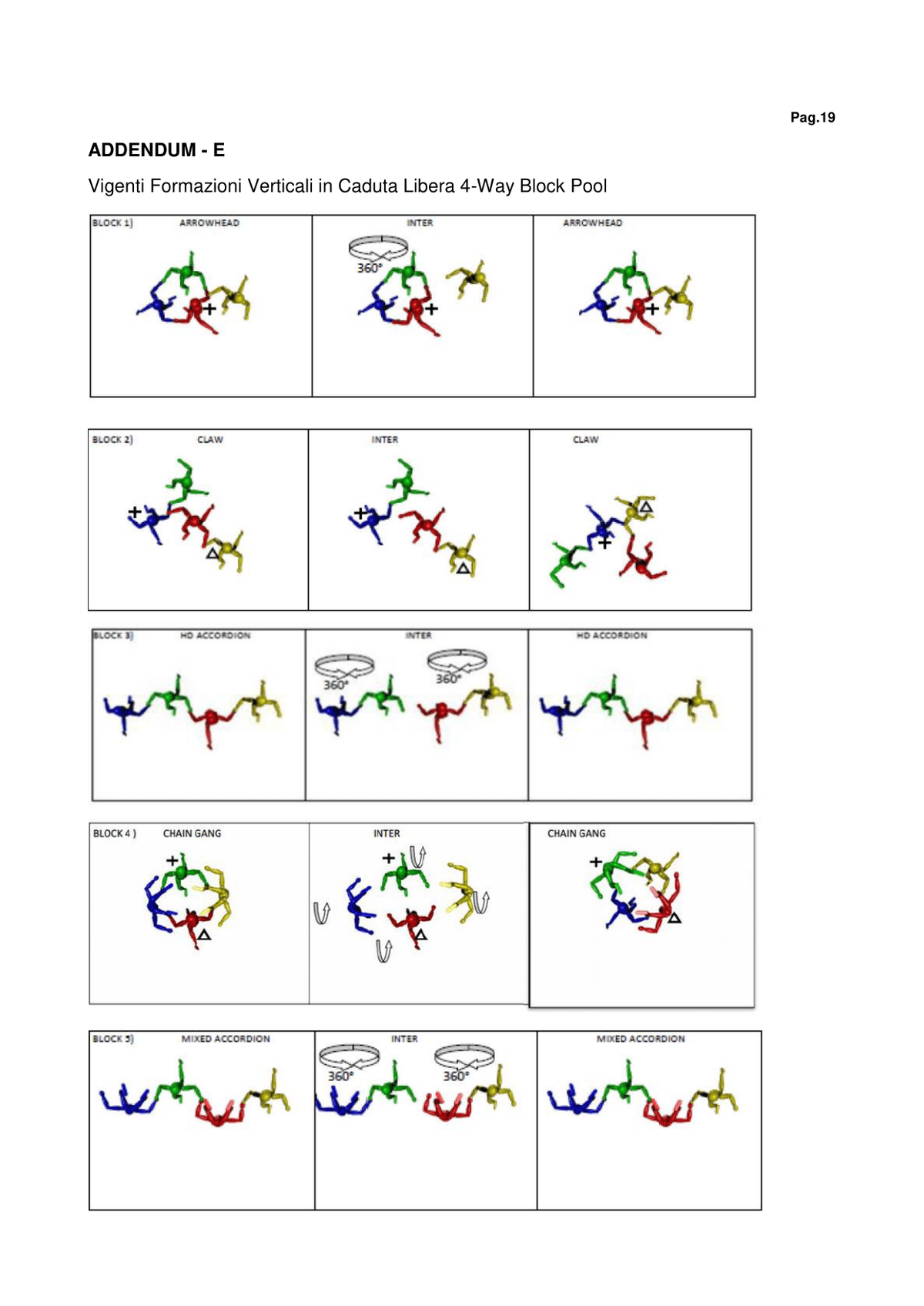
VFS diagrams are color-coded (one color per athlete) and show vertically-oriented skydivers. Arrowhead · Claw · He Accordian · Chain Gang · Hyper Accordian · Snow Flake → Big OD Snow Flake · Flurries · Buddy · Galaxy · Ball · Fun Buddies · Pinwheel · 4D Star · Satellite · Ballet · Constant · DNA · Ding · Angry Pelican · Box · Top Spot · Core Buddies.
Addendum F — 4-Way VFS Random Pool · 16 figures
Cross (A) · Gulley (B) · Shoeshine (C) · Sitline (D) · Wave (E) · Double Joker (F) · Mixed Star (G) · T-Bird (H) · Flock (J) · Anchor (K) · Rebel (L) · Dentri (M) · Double Rebel (N) · Trident (O) · Cortex (P) · Mixed Wave (Q). A circle in the diagram indicates a foot grip.
📖 All 114 formations with the official Regulation diagrams — searchable by figure name, filterable by event and kind — are in the Quota 4000 Dive Pool Browser: /practice/disciplines/dive-pool. Built for quick hangar reference.
International reference standards
The Italian Technical Regulation is aligned to the FAI Sporting Code, Section 5 (parachuting), approved by the IPC. The FCL/VFS discipline is part of the FAI World Championships programme and European competitions.
Quick IT/EN glossary
- Formazioni in Caduta Libera → Formation Skydiving (FS)
- Formazioni Verticali in Caduta Libera → Vertical Formation Skydiving (VFS)
- Tempo di lavoro → Working time
- Presa → Grip
- Separazione totale → Total separation
- Blocco / Block Sequence → Block
- Figura libera / Random Formation → Random
- Catalogo figure → Dive Pool
- Infrazione → Bust
- Omissione → Omission
- Capo Giudice → Chief Judge
- Operatore Video → Video Operator
- Rilancio → Rejump
FAQ
- What are the three events of the Italian FCL/VFS Championship?
- Three official events: 4-Way FS (4 skydivers, belly, 35-second working time, exit at 3,050 m AGL), 4-Way VFS (4 skydivers, vertical head-down/head-up, 35 seconds at 3,960 m AGL) and 8-Way FS (8 skydivers, belly, 50 seconds at 3,960 m AGL).
- How is a round of FCL/VFS scored?
- Teams earn 1 point for every valid formation completed in the sequence within the Working Time; once the sequence is complete, it restarts from the beginning. Omitting a formation costs –3 points. The minimum score per round is zero (no negatives).
- What is the Dive Pool?
- The Dive Pool is the official catalog of all competition figures: it includes Random Formations (single figures, identified by letters) and Block Sequences (transitions, identified by numbers), described in the Regulation Addenda. Round sequences are drawn from this catalog before each round. 114 formations total: 22 blocks + 16 randoms for each of the 3 events.
- Who is the governing authority for the Italian Championship?
- The Aero Club d'Italia, in compliance with the Regolamento Sportivo Nazionale (RSN) and the rules of the FAI Sporting Code, General Section and Section 5, approved by the IPC (International Parachuting Commission). By entering the Championship, every competitor accepts those rules as binding.
- When is a rejump granted?
- A rejump is only granted in case of NV (Not Visible) — when formations, inters or total separations are not visible on video due to weather conditions or technical issues with the video equipment. It is not granted for contacts between teammates, adverse weather during the jump, or technical issues with competitors' equipment.